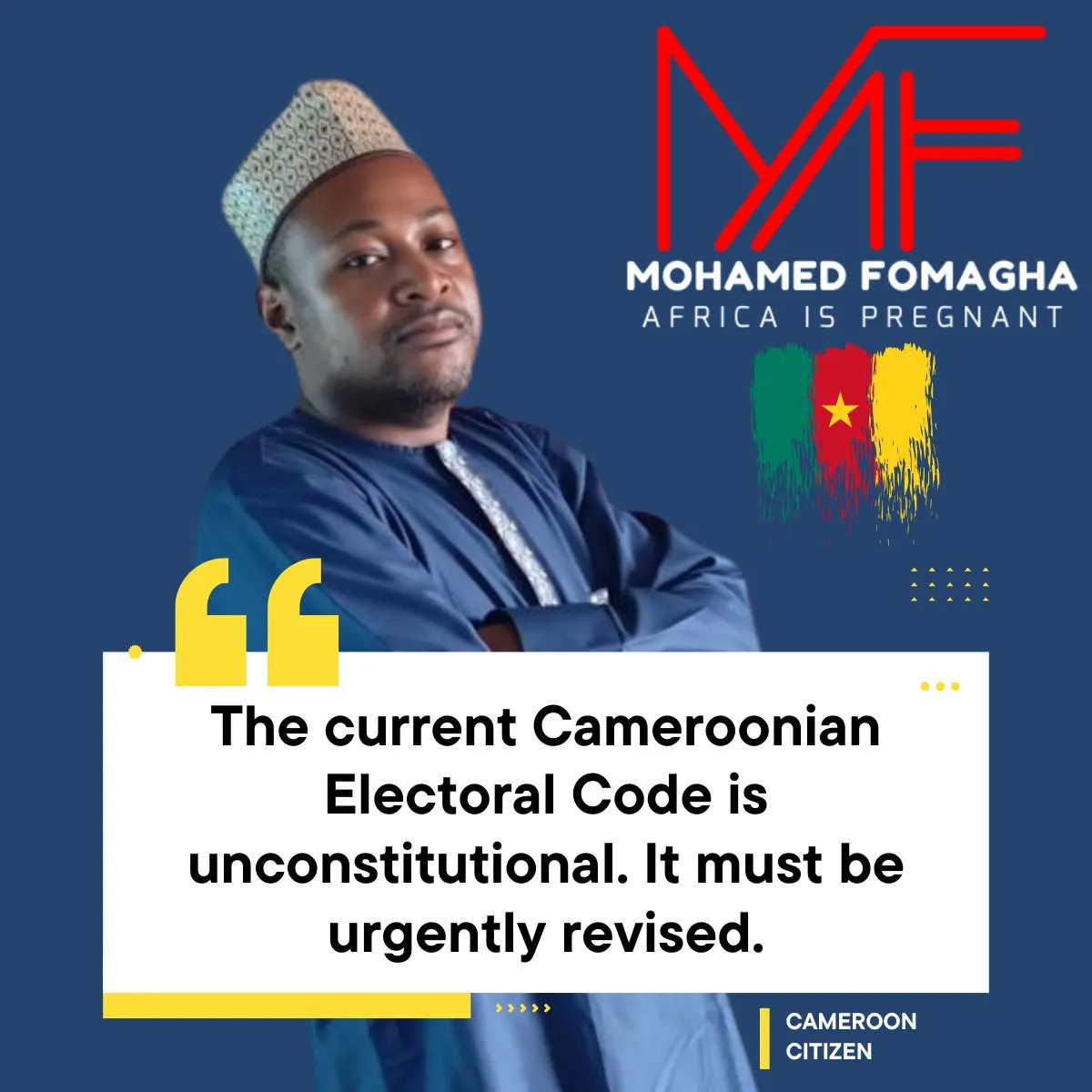
By Mohamed Fomagha
In any Republic that claims to be democratic, the Constitution is the supreme norm. It embodies the general will, lays the foundation of the rule of law, and guarantees the fundamental freedoms of citizens. Yet in Cameroon, a worrying reality is emerging: the current Electoral Code is a serious violation of the Constitution and poses a significant threat to the credibility of the electoral process. It has become the very tool by which popular sovereignty is stifled and political pluralism suppressed. It is urgent to denounce it, deconstruct it, and demand its immediate revision.
A Constitution Betrayed by the Laws Meant to Uphold It
The Preamble of the Cameroonian Constitution, which forms part of the legal text, enshrines the fundamental rights of every citizen — including the right to vote, to stand for election, and to participate in public affairs. Article 1(2) clearly states:
« National sovereignty shall be vested in the people of Cameroon as a whole. No section of the people nor any individual shall arrogate to itself or himself the exercise thereof. »
Article 6(2) is even more explicit:
« The President of the Republic shall be elected by direct and secret universal suffrage for a term of seven years. He shall be eligible for re-election. Any Cameroonian citizen of either sex enjoying their civil and political rights and aged thirty-five years and above may be a candidate. »
Nowhere does it impose additional requirements. There is no mention of endorsements, quotas, or any political prerequisites. The Constitution is clear, straightforward, and unambiguous.
Yet, what does the Electoral Code do?
An Electoral Law That Usurps Constitutional Authority
The Cameroonian Electoral Code, in its current form, arrogates powers not granted to it by the Constitution. It introduces liberty-crushing, discriminatory and selective provisions, which blatantly contradict constitutional principles such as equality, freedom of participation, and popular sovereignty.
Take for instance Article 121 of the Electoral Code. It requires independent candidates to be endorsed by at least 300 personalities from all regions of the country (30 per region), selected from a narrowly defined social class: traditional rulers, MPs, municipal councillors, etc. In a political landscape where local institutions are firmly under government control, this amounts to a political barrier. In short, a citizen not favoured by the regime is excluded from the start.
This provision appears nowhere in the Constitution. It creates de facto inequality among citizens, violating Article 1(2) on national sovereignty and Article 6(2) on the right to stand for election. Even worse, it transforms a universal right into an oligarchic privilege, reserved for a regime-controlled elite.
The Case of « Unrepresented » Parties: An Illegal and Scandalous Exclusion
While the Electoral Code does not explicitly state that a political party must have elected officials in order to field a presidential candidate, this logic has unfortunately taken root in political practice. For example, the Cameroon Renaissance Movement (CRM), which boycotted the 2020 legislative and municipal elections in protest against flawed electoral conditions, is now under threat of exclusion from the upcoming presidential election simply because it lacks parliamentary representation.
Such an approach is legally baseless and politically dangerous. A political party’s right to nominate a candidate does not depend on the number of elected officials it has, but rather on its legal existence as a duly recognised political entity. The CRM is legally registered and therefore fully entitled to participate in national elections.
To impose a « representation » condition is to reserve the political process for regime allies and to exclude any credible alternative. It is a grave violation of democratic pluralism.
The Constitutional Council Must Rise to Its Duty
In the coming months, the Constitutional Council will have the heavy responsibility of validating presidential candidacies. Should it uphold exclusions based on unconstitutional criteria, it will have betrayed its very mission: to ensure the conformity of laws with the Constitution.
If that happens, one must state the truth without equivocation: Cameroon will no longer be a state governed by the rule of law. It will become a republic of legal fraud, where inferior texts override the supreme law of the land.
Conclusion: The Time for Reform is Now
The current Cameroonian Electoral Code is a legal and political scandal. It violates the Constitution, infringes on citizens’ fundamental rights, and rigs the rules of democratic engagement. It is a law of exclusion, a law of manipulation, a law designed to block political change.
No country can claim stability while denying its citizens the right to freely choose their leaders. No regime can endure by suffocating the people’s voice through unjust legal mechanisms.
This is why it is imperative, urgent, and vital to revise the Electoral Code and bring it into alignment with the Constitution and international democratic standards.
Democracy cannot be begged for. It must be demanded. And it begins with unwavering respect for the Constitution.
Aucune réponse